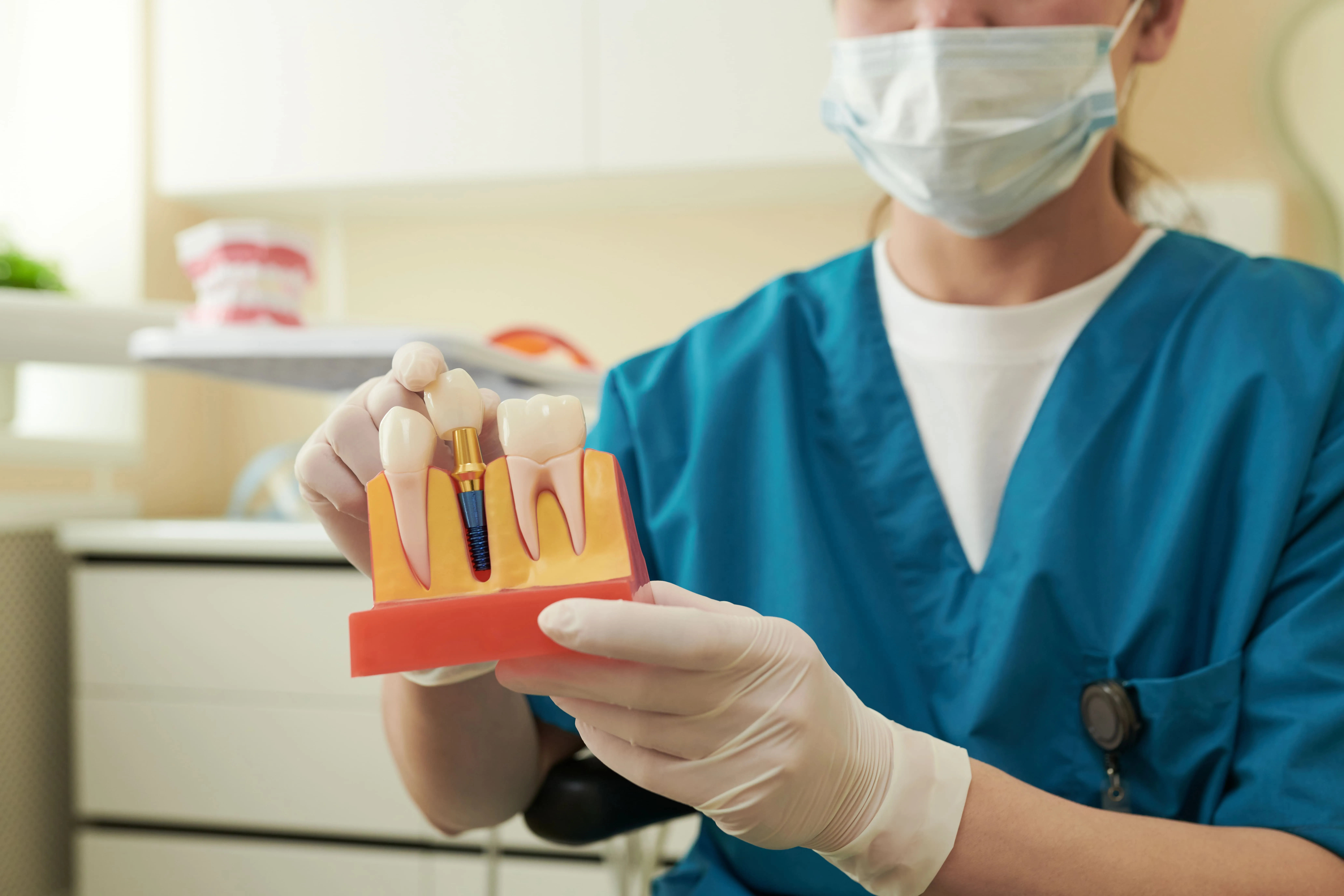
Dental implants are artificial tooth roots designed to replace missing teeth and restore oral function. Dental implants in Dubai at DRFK are planned with same day dental implants in mind for eligible patients, allowing an implant and temporary restoration during the same visit when bone quality, implant stability, and treatment planning all support it, under Dr. Mohammad Hayem Zin Alabdin.
DRFK Turkish Medical Center is located at Villa 2, Al Athar Street, Jumeirah 3, Dubai. The clinic is easily accessible from Jumeirah, Umm Suqeim, Al Safa, Business Bay, and Downtown Dubai within around 15 minutes via Sheikh Zayed Road, with on-site parking available.
CBCT-guided planning on every case, immediate provisional options when clinically appropriate, and prosthetic coordination under one roof.
Dental implants in Dubai are titanium fixtures designed for permanent osseointegration, replacing the root of a missing tooth so crowns, bridges, or full-arch prosthetics can attach. They restore chewing function, speech, and aesthetics while preserving jawbone volume, something a removable denture cannot do, since dentures sit on the gum rather than stimulating the bone underneath.
Missing teeth don't just affect appearance, and most competitor pages stop at "replace the tooth" without explaining what's actually happening underneath.
Bone resorption: the jawbone naturally shrinks once it no longer receives stimulation from a tooth root, accelerating the longer a gap is left untreated
Tooth function: adjacent teeth can shift or tilt into the gap over time, affecting bite alignment
Facial support: long-term tooth loss in multiple areas can subtly affect facial structure and lower-face support
Oral health impact: gaps make adjacent teeth and gums harder to clean, raising decay and gum disease risk
This is why implants are considered the standard of care for missing teeth rather than a cosmetic upgrade, since a titanium fixture replaces the root itself and continues stimulating bone the way a natural tooth would.
Osseointegration is the actual mechanism that makes an implant function like a natural tooth root rather than a removable solution sitting on top of the gum.
| Component | Function |
|---|---|
| Implant Fixture | Titanium post placed into the jawbone, acting as the artificial tooth root |
| Abutment | Connector piece linking the fixture to the visible restoration |
| Dental Crowns (or Bridge/Prosthesis) | The shade-matched visible tooth replacement attached to the abutment |
| Osseointegration | The biological process where bone fuses to the titanium fixture, providing permanent anchorage |
Most patients never get told there's a material choice involved at all, but it affects both biocompatibility and aesthetics.
Titanium implants: the long-established standard, with decades of clinical data supporting osseointegration and long-term success rates
Zirconia implants: a metal-free, tooth-coloured alternative sometimes preferred for patients with thin gum tissue where a titanium fixture's grey tone might show through, or for patients seeking a metal-free option
Material choice is assessed individually based on gum thickness, aesthetic zone (front vs back teeth), and any metal sensitivity history, rather than defaulting to one material for every patient
Same day dental implants allow eligible patients to receive the implant fixture and a temporary restoration, a provisional crown or bridge, in the same appointment rather than waiting months between surgical placement and a visible tooth. This is possible when bone quality, the absence of active infection, smoking history, and systemic health all support sufficient primary stability, confirmed intraoperatively during the procedure itself.
Same-day teeth implants are not automatically available to every patient who asks for them. Eligibility is confirmed through CBCT imaging and clinical assessment before the day of surgery, not decided on the spot, and same day dental implants remain one of the most requested but least understood parts of modern implant dentistry.
This is the actual science behind whether a same-day result is realistic for a given patient, and it's almost never explained on competitor pages.
Primary stability: how firmly the fixture sits in the bone immediately after placement, measured during surgery
Implant torque: the resistance felt while seating the fixture, used as a real-time indicator of bone engagement
Implant Stability Quotient (ISQ): a numeric stability reading used to support same-day loading decisions
Temporary restoration: a provisional crown or bridge fitted the same day, replaced with the final prosthesis once healing and osseointegration are confirmed
If primary stability isn't sufficient at the time of surgery, the responsible approach is to delay loading rather than force a same day teeth implants result that risks the implant's long-term success.
Eligibility for same day dental implants depends on a combination of clinical factors assessed before surgery is ever scheduled.
Adequate bone density and volume at the implant site, confirmed via CBCT
No active oral infection in the treatment area
Controlled diabetes and stable systemic health
Non-smoking status, since smoking significantly raises implant failure risk
Sufficient primary stability confirmed intraoperatively, even after a positive pre-surgical assessment
Patients who don't meet same-day criteria are not excluded from implants altogether. A staged approach, placing the fixture first and adding the crown after osseointegration, remains a safe, well-established alternative.
Implant failure is rare when patients are properly screened, but it isn't zero risk, and an honest page should say so rather than implying guaranteed success.
Smoking, which significantly impairs healing and bone integration
Uncontrolled diabetes or other systemic conditions affecting wound healing
Insufficient bone density at placement that wasn't adequately addressed beforehand
Poor oral hygiene around the implant or healing abutment during recovery
Excessive bite force on a provisional restoration before it's fully stable
Peri-implantitis, a gum infection around the implant that develops from inadequate maintenance over time
Most of these factors are identifiable and manageable before surgery through CBCT review, medical history screening, and a realistic conversation about candidacy, which is exactly why DRFK doesn't promise same-day results to every patient regardless of risk profile.
Digital planning is the difference between an implant placed by estimation and one placed with millimetre-level precision.
CBCT imaging: three-dimensional scanning of the jawbone, nerve position, and sinus anatomy before any surgical decision is made
3D treatment planning: implant position, angle, and depth mapped digitally against the CBCT scan
Surgical guides: physical or digital guides used during placement to match the pre-planned position exactly
Precision placement: reduces the margin for error around nerves, sinuses, and adjacent tooth roots
DRFK's CBCT Scan Dubai and implant planning service supports this process for every case, whether the result is same-day or staged.
| Factor | Dental Implant | Dental Bridge |
|---|---|---|
| Adjacent Teeth | Not affected, no preparation needed | Requires shaving down neighbouring teeth for support |
| Jawbone | Preserved through ongoing stimulation | Continues to resorb under the gap |
| Longevity | Can last indefinitely with hygiene and surveillance | Typically needs replacement after 10 to 15 years |
| Procedure | Surgical placement, longer initial timeline | Non-surgical, faster initial fitting |
| Best For | A permanent, bone-preserving solution | A faster, non-surgical fix |
This comparison gets searched constantly, and most clinics either skip it or oversimplify it, when implants and veneers solve completely different problems.
Different indications: dental implants replace missing teeth entirely, while veneers cover the visible surface of existing, structurally present teeth to improve shape, shade, or alignment appearance
Tooth preservation: veneers require minimal preparation of the existing tooth, while an implant doesn't touch adjacent natural teeth at all but requires the original tooth root to already be missing
Functional differences: an implant restores chewing function at the root level, while a veneer is purely a surface restoration with no root function
If you're researching a dental veneers in Dubai because you have intact but cosmetically uneven teeth, that's a Dental Veneers Dubai conversation, not an implant one. If you're missing a tooth entirely, implants are the relevant comparison. Patients planning a full smile restoration involving multiple teeth often combine implants for missing teeth with Hollywood Smile Dubai veneers for the remaining natural teeth, coordinated through Cosmetic Dentistry planning under one treatment plan rather than two separate, disconnected processes.
Implant treatment scales from a single gap to a full arch, and the planning approach changes significantly at each level.
Single tooth implant: one titanium fixture topped with a shade-matched ceramic crown, conservative biomechanics for a solitary gap
Multiple implants: several fixtures placed to support individual crowns or a connected bridge across multiple missing teeth
All-On-4 Dental Implants: four strategically angled implants supporting a full-arch fixed prosthesis, often reducing the need for bone grafting in cases with bone loss
All-on-6: six implants distributed across the arch for additional support in cases needing greater load distribution
DRFK's Full Mouth Rehabilitation and Dental Crowns team coordinates the final restoration phase for both single-tooth and full-arch cases under CAD-CAM digital workflow.
Not every jaw has enough bone volume to support an implant immediately, and this is one of the most commonly skipped topics on competitor pages.
Guided Bone Regeneration (GBR): rebuilding deficient bone using grafting material and a barrier membrane
Block grafting: using a solid block of bone graft material for more significant volume deficiencies
Sinus lift: raising the sinus floor in the upper jaw to create sufficient bone height for implant placement
When grafting is required, it typically adds healing time before the implant can be placed, which is why CBCT assessment early in the process matters, it tells you upfront whether grafting will be part of your treatment plan rather than discovering it mid-procedure.
Osseointegrated titanium fixtures can last indefinitely with proper hygiene and surveillance, although the crown attached to the implant may need renewal after years of normal wear, similar to how a natural tooth's enamel wears over decades.
Maintain meticulous hygiene around the implant and healing abutments
Attend scheduled review appointments for torque testing and prosthetic progression
Avoid smoking, which significantly raises long-term implant failure risk
Inform your clinician about bisphosphonate use or radiation history, both of which affect bone healing
Keep diabetes tightly controlled, since uncontrolled blood sugar affects healing and integration
Watch for early signs of peri-implantitis, such as bleeding or swelling around the implant, and report it promptly
Most dental implant surgery is performed under local anaesthesia, with sedation available as an option. Patients typically report pressure rather than sharp pain during the procedure, with mild soreness resolving within days.
Mild swelling or bruising is common in the first 48 to 72 hours, managed with cold packs and prescribed medication
Chlorhexidine rinses may be prescribed to support healing around the surgical site
Provisional restorations should be protected from excessive bite force during early healing
Final crown placement follows a CBCT-confirmed healing schedule before uncovering the implant for the final restoration
DRFK Turkish Medical Center is a same day dental implants clinic built around consultant-led planning rather than a high-volume, one-size-fits-all approach.
Dr. Mohammad Hayem Zin Alabdin, board-certified Consultant in Oral Surgery and Implantology with 20+ years of experience in oral and maxillofacial surgery
DDS from the University of Damascus and a German Board of Oral Surgery (Facharzt) qualification
CBCT-guided digital implant planning and surgical guides on every case, never estimation-based placement
Same-day eligibility confirmed only after CBCT review and intraoperative stability testing, never promised upfront without assessment
Multidisciplinary coordination between Oral Surgery, Prosthodontics, and restorative dentistry under one roof
Full mouth rehabilitation pathways, from single-tooth implants through All-On-4 Dental Implants and full-arch restoration
DHA-licensed facility with CAD-CAM prosthetic workflow for precise, shade-matched final restorations
Strict sterilisation protocols and an implant maintenance programme with scheduled follow-up review visits
Personalised treatment planning rather than a fixed implant package applied to every patient
The final cost of dental implants treatment Dubai patients receive depends on implant count, whether grafting is needed, implant material, and prosthetic design. DRFK provides a personalised estimate only after CBCT assessment and clinical planning, since pricing before imaging would not reflect your actual case. Many insurance plans offer partial restorative coverage, and the team supports the pre-authorisation workflow before treatment starts.
Titanium fixtures with custom crowns, biomimetic spacing and occlusion.
Provisional teeth same appointment when stability and biology align.
Full-arch fixed prosthetics on strategically angled implants.
GBR, block grafting, sinus lifts to rebuild deficient ridges.
Inform clinicians about bisphosphonates or radiation history.
Control diabetes tightly peri-operatively.
Use chlorhexidine rinses if prescribed.
Protect provisional prostheses from excessive bite forces.
Follow CBCT scheduling before uncovering final crowns.
Medically reviewed by Dr. Mohammad Hayem Zin Alabdin, Consultant in Oral Surgery and Implantology, DRFK Turkish Medical Center, Jumeirah 3, Dubai.
Every day: 9:00 AM – 6:00 PM
Villa 2 Al Athar Street, Jumeirah 3, Dubai, United Arab Emirates
